Three Ways to Tell a Gay Story
- Film
- Culture
- Ideas
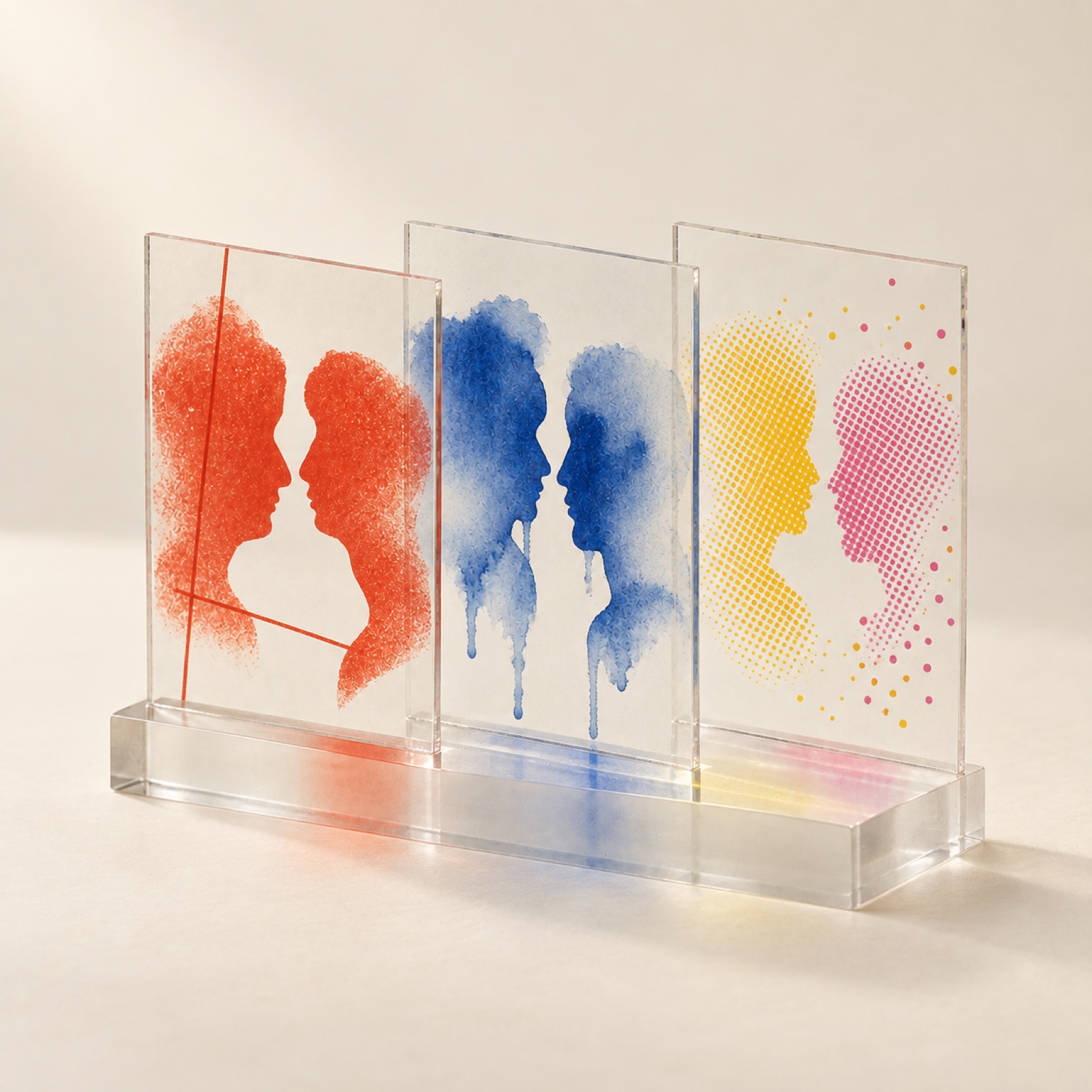
In Cardcaptor Sakura (a children's anime from the late 1990s) the heroine's older brother, Touya, is quietly, canonically in love with his best friend Yukito. The young rival Syaoran arrives and gets a flustered crush on Yukito too. So does Sakura, the heroine. Eventually Sakura and Syaoran fall for each other instead. The story flags none of it. There is no coming-out scene, no moment of crisis, no statement. A boy loving a boy and a girl loving the same boy sit in the same emotional register, handled with the same shrug, given no special weight at all. That casualness in a children’s anime from the 1990s still strikes me. Western children’s animation has since made room for queer romance too, but Sakura did not wait for it.
The default, not the exception
It's not an isolated case. Hunter × Hunter is built on the fierce, all-consuming companionship of Gon and Killua, read by much of its audience as something past friendship and never corrected by the text. Kurapika’s appearance is androgynous without the story making that a problem to resolve. Killua insists, lovingly and flatly, that his sibling Alluka (and Nanika, the entity inside her) is his sister, while the cold Zoldyck family calls her a thing, a boy, an it; the cruelty belongs to them, not to the story. Evangelion gives Shinji his charged bond with Kaworu alongside his entanglements with Asuka and Rei, and treats the whole tangle as continuous rather than sorted into boxes. Well below serious drama, the same ease gives us the femboy (Astolfo, Felix): androgynous characters with elaborate styling, sometimes cat ears, and grand European names, played sometimes for beauty and sometimes for laughs, but rarely for controversy. Across the medium, from masterpieces to throwaway cameos, sexuality and gender are mostly nothing new and nothing special. Not a theme to be handled. Just material.
One important root of that aesthetic ease is the bishōnen, the "beautiful boy" of Japanese shōjo manga: tall, slim, fine-featured, the male body drawn to be looked at and longed for rather than to hold power. That template did not stay in Japan. In late-1990s South Korea it became the kkonminam, the "flower boy": the same soft, pretty, carefully groomed masculinity, what the scholar Sun Jung called a pan-East-Asian "soft masculinity" combining the pretty-boy influence with Korean traditions of cultivated, restrained masculinity and a global interest in grooming. It became a powerful alternative to the older hypermasculine ideal. Boys Over Flowers, one of the foundational flower-boy K-dramas, is literally adapted from a Japanese shōjo manga, the borrowing right there on the page.
From there the aesthetic became load-bearing for an entire industry: the look of K-pop idols, the casting logic of K-drama male leads, and later the whole webtoon era, which now loops back into both. They feed each other constantly, and the result is bleeding into Western pop culture: the soft, styled, openly pretty male image turning up in Western music and fashion decades after it was standard in Seoul and Tokyo. East Asian media built a huge mainstream business around male beauty and male-male feeling long before the West could look at either without flinching. That is the soil BL grew in.
Three functions
I find it useful to distinguish three functions a gay story can serve. They overlap, and the differences concern purpose rather than quality.
The first function is critique. The LGBTQ+ mode: activist, political, the character set against a system, the narrative built to indict that system. Philadelphia, Milk, Dallas Buyers Club, BPM, most of the Western awards slate. This work is often necessary and often very good. But its argument can dominate what it offers as entertainment. Straight audiences get relatable, aspirational versions of themselves constantly, by default; the activist mode does close to the opposite for a gay viewer, framing the identity first as a battleground. It can affirm and alienate in the same gesture.
The second function is lament. The queer/tragic mode: suffering, loss, the love punished or arriving too late. Less systemic, more interior, but still built around pain. Brokeback Mountain, Call Me By Your Name, A Single Man, Moonlight, God's Own Country. Some of the most beautiful films in the canon live here. They are also, structurally, about something that hurts, a heavy thing to carry as the default register for a whole category of person.
The third function is simply to entertain: to tell a story about two people who happen to be men with no thesis attached, the way the overwhelming majority of straight romance asks nothing of itself beyond being a romance. The West has always been bad at this; the instinct routes nearly every gay story into critique or lament. Its recent attempt at the third function (the "queer joy" corrective of Heartstopper and Red, White & Royal Blue) is real but still self-conscious, still aware of itself as a corrective, still half a statement about the right of gay stories to be happy. East Asia got there decades earlier, and from a completely different direction: BL.
What BL actually is
Contemporary boys' love traces to 1970s Japan, inside shōjo manga. The loosely grouped women artists later called the Year 24 Group (Moto Hagio, Keiko Takemiya and others) stretched the form to hold psychology, gender, and sexuality, and in the process invented male-male romance as a subgenre. Takemiya's Kaze to Ki no Uta and Hagio's The Heart of Thomas are the foundational texts; June, launched in 1978, was the first dedicated magazine; the genre spread into anime through the 80s and 90s. The decisive fact is that BL was made by women, for women, and largely remains so, to the point that its fandom carries the reclaimed term fujoshi, "rotten girl." That it took root in Japan is no accident: the culture had a long prior tradition of homoerotic art, from shunga prints to the well-documented affairs between samurai and their younger companions.
This origin is the blessing and the asterisk. The blessing is that BL tells gay stories for their own sake, free of any duty to argue or to mourn. The asterisk is that, made for a female gaze, it is often not about gay men's lives at all: it is fantasy, and at its worst it fetishizes. So the map of BL is mostly a map of how far a given work sits from that fan-service origin, and the most useful axis is what the fan service is made of.
The axis
At one end is fan service as raw, low-budget heat. Addicted, the 2016 Chinese web series, is the emblem: cheap, electric, and far more consequential than its budget had any right to be, pulled by Chinese censors three episodes before its finale, and followed by further restrictions on same-sex content. The censorship had a longer history; this was a particularly visible confrontation with it.
A step along is fan service as plot and tension, where the charge between the leads is the structure rather than a garnish. Semantic Error, an early and modestly produced Korean BL, works exactly this way.
Then the commercial center, where the fan service is all surface: the lingering touches, the abs, the manufactured chemistry doing the work the writing doesn't. KinnPorsche and a long tail of titles like Double Helix, Revenged Love, and ABO Desire live here. This is BL as spectacle, accounting for most of the genre by volume.
Further along sits spiritual partnership, where the fan service turns philosophical and visual rather than physical: the wuxia and xianxia historicals. Heaven Official's Blessing, Word of Honor, and above all The Untamed, adapted from Mo Xiang Tong Xiu's The Grandmaster of Demonic Cultivation. The Untamed is the essential case: it never shows a kiss, leans hard into honor and beauty, and was coded so thickly anyway (the chemistry between two national stars so obvious) that it set off a colossal shipping phenomenon and became part of the cultural backdrop to the 2021 crackdown banning live-action danmei adaptations and "effeminate" men from Chinese screens. The second censorship wave was a response to how loudly a chaste show could speak.
At the far end is what's best called author BL: closer to auteur cinema than to genre product, defined by two refusals. It puts almost everything into what its characters feel and how they actually live, and it throws out the fan service, or very nearly all of it. The BL-ness becomes secondary: these are stories about people who happen to be gay, where the character is neither a mouthpiece for an argument nor a body to be consumed. Love in the Big City (the series, more episodic and more interesting than the film, adapted from Sang Young Park's novel) sits squarely here. It follows a gay man across years of friendship, sex, illness, and his complicated bond with the woman he lives with, and it is open and explicit precisely because it has no interest in coding anything: it is finally writing from inside gay life rather than toward a fantasy of it.
Past the frontier
It's at that frontier, pushing past it, that the two most interesting recent works sit.
Soul Mate takes the auteur logic and strips out the fan service, then keeps going and strips the decoration off romance itself — desire, declaration, the physical proof — leaving only the core: two damaged people who become each other's shelter across ten years and three cities.
The Summer Hikaru Died goes further still, by refusing the category outright: its author describes it as coming-of-age horror rather than organizing it around the expectations of romance. The relationship between Yoshiki and the entity wearing his dead friend's face is unmistakably queer and unmistakably intimate, and it is also, deliberately, not a romance in any shape the genre would recognize. Otherness, grief, identity, devotion, carried by two boys.
Which is either the logical endpoint of the auteur tendency or its escape from the genre altogether. Probably both.