The Summer Hikaru Died and the Tenderness of Monsters
- Film
- Design
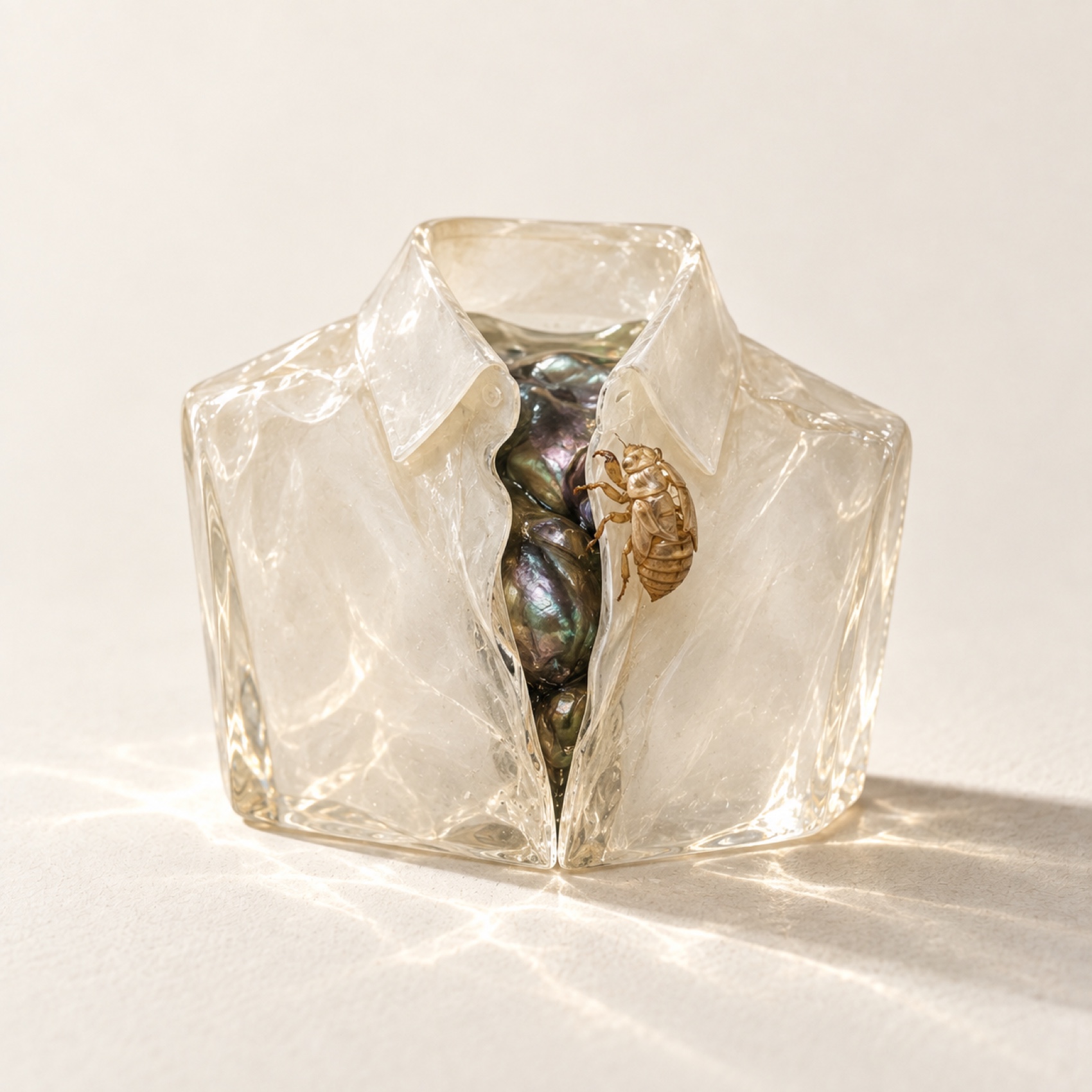
The premise reads as horror, and in places the show is genuinely frightening, but the monster is not there to frighten you. He is there to be loved, and to love back, and most of the horror is just the friction of those two facts against a world with no room for either. The Summer Hikaru Died uses the supernatural to make literal what intimacy usually only implies.
In January, in an isolated village in rural Mie, a boy named Hikaru is dying alone on a forbidden mountain when something the villagers call Nonuki-sama finds him, consumes him, and takes his shape, keeping his memories, his voice, his warmth, while being something else entirely underneath. A week later this new Hikaru walks back into the village claiming to remember nothing. Six months pass. And then, on an ordinary stifling afternoon, sharing a cold drink the way they have since childhood, his best friend Yoshiki says it out loud: you're not Hikaru, are you?
The bargain
I will call him Hikaru (monster) throughout, because the show makes him a fuller, more present, more real character than the boy he replaced, and "the creature" would be a lie about how tenderly the series treats him. He is caught completely off guard. I thought I copied him perfectly. And then he begs. Not to be told on. It is his first time alive as a human and he is enjoying it; he likes Yoshiki, a whole lot; and folded into the plea so gently you could miss its weight is the thing he barely knows how to say: if the secret breaks, he will have to kill him.
Yoshiki, who loved the real Hikaru and has just had the loss confirmed in the worst way imaginable, agrees to keep it. Not out of fear. Because a copy of Hikaru is better than a world without one.
From that afternoon the series becomes something very precise: a story about two people bound by a secret, and about the particular, conspiratorial intimacy that only a shared secret can build. The whole village is quietly full of watching things and arriving investigators, and having to hide it presses the two of them together into a closeness with nowhere to go but inward.
Two outsiders, not one mourner
This goes beyond a boy mourning his friend and settling for a replacement: two outsiders recognize each other.
Yoshiki has always been the odd one: alone in a way that started long before any of this, alien to the rhythms everyone else moves to, watching the world from somewhere behind his own eyes. He has spent his whole life playing the part of a normal person, and playing it well enough that no one looks twice. Then Hikaru (monster) arrives, and for the first time there is someone else on the outside of the glass, looking in alongside him. Another observer. Another pretender wearing a human face it doesn't quite fit. The loneliness of being unlike everyone finally breaks because the person beside him is, now literally, unlike everyone. And on top of that impossible gift: the Hikaru he loved looks back at him and returns the feeling. Suddenly Yoshiki is not alone. Suddenly he is wanted. Suddenly he is needed. Suddenly there is someone to be fascinated by, and someone fascinated back. He does not love Hikaru (monster) as a discount version of the original. He arguably loves him more, because the monster is the only creature alive who shares the exact condition of his life.
And the feelings running the other way cannot simply be reduced to inheritance. The lazy reading is that Hikaru (monster) simply carries the dead boy's affection forward like a file copied to a new drive. His feeling grows visibly out of his own situation: out of being seen by Yoshiki as exactly what he is and not turned away; out of being sheltered instead of exposed; out of being something Yoshiki is curious about and takes care of; out of being, for the first time in his strange short existence, chosen. There are reasons for the feeling to grow out of this new life too, and you can watch them accumulate.
Whose feeling is it
None of which settles the harder question the show keeps alive. At his lowest, Hikaru (monster) confesses that he is losing his mind, because he can no longer tell which of his feelings are his own and which belonged to the boy he is wearing.
The animation says it before the dialogue does: the real Hikaru, in flashback, almost never looks directly at Yoshiki, while Hikaru (monster) looks at almost nothing else. When Yoshiki asks whether he likes him and the answer comes back instant, certain, and enormous, Yoshiki weeps because the real Hikaru never said that. The copy loves him more legibly than the original ever managed.
So whose feeling is the true one: the buried thing the dead boy may have carried and never said out loud, or the spoken, maybe-borrowed, maybe-newborn thing that is the one actually holding him through the night? The show's bet is that a feeling fully present and fully given may not be worth any less for where it came from. We are all, in our attachments, running some amount of borrowed code: loving partly out of memory, circumstance, and who we needed someone to be. Hikaru (monster) just has to suffer the ordinary version of that as a literal crisis of identity.
The seam, and what comes after it
The wanting and the dread meet most clearly in two scenes, in the order the show gives them.
The first is the chest. Hikaru (monster) opens his shirt and shows Yoshiki the seam — the gap running through his body where the human surface gives way to whatever he really is — and he does it as an invitation. He tells Yoshiki to look, to enjoy it, fully aware that Yoshiki is drawn to this body, the body of the boy he loved. By every rule of the genre it should play as grotesque. Instead it is strange and playful and tender: an offering, a show of trust, flirting through impossible anatomy. And then the moment the scene actually turns on: Hikaru (monster) discovers that he likes being touched by Yoshiki. He doesn't flinch from the hand inside him; he pulls Yoshiki in. The monster wanted to be touched, and is startled, almost shy, at his own wanting. It is one of the most erotic scenes I have seen in animation, and nothing about it is shaped like sex.
The second comes later and runs darker. The wanting overruns him: Hikaru (monster) snaps and invades Yoshiki, pushes into him, and for a horrified instant Yoshiki registers, against everything, that it feels good. And then Hikaru (monster) pulls back. He crashes out of it, terrified of what he nearly did, because the same being who wants Yoshiki that badly cannot bear the thought of harming him. Desire and care, housed in one body, at war and inseparable.
The knife
The cost of all of it lands hardest when Yoshiki decides he has to end it. People are dying in the village, and Hikaru (monster) is tangled in the deaths, and out of a real and agonized sense of duty Yoshiki resolves to stop it. He does not know that the monster cannot be killed. He stabs him believing it might actually work, believing it might be the right thing, and coming apart over it the entire time.
Hikaru (monster) doesn't fight. He lets his true form show, struggles aloud with what being human even means to him, tells Yoshiki that being with him was the first time he ever had a place to belong, then tears off half of his own body and gives it away, weakening himself, keeping his own power in check: pure devotion, offered in answer to someone trying to kill him. And Yoshiki accepts him again. Of course he does.
Underneath everything sits a moral weight the show never lets resolve. Yoshiki is harboring, hiding, sheltering, and falling in love with the thing that consumed and replaced his best friend, who was also the first person he ever wanted. The lost friend and the new beloved have the same face, and he cannot mourn the one without betraying the other. The series refuses to file this down into a lesson. It lets it remain what it actually is: the impossible, ongoing weather of his life.
You are my monster
There is one scene I keep returning to. Yoshiki has been angry with Hikaru (monster), and Hikaru (monster), a thing that ate a boy on a mountain with no reason to care about human feeling at all, is in his room under the covers, crying because the person he loves is upset with him. A monster, weeping like a child, because of love. And Yoshiki comes to him and accepts him, the way you forgive someone you have already decided to keep. Over it plays TOOBOE's "You Are My Monster," the ending theme pulled forward into the scene, and the title isn't a metaphor. You are my monster. Mine. The possessive carries the entire series.
Clumsy handling would ruin this. The craft is extraordinary. Ryōhei Takeshita's direction stays restrained where a lesser hand would go lurid, and keeps the body horror pointed at something instead of just being disgusting. The drawing style is specific, confident, quietly gorgeous, and the rural summer comes off the screen with a heat you can feel. The writing trusts silence, trusts saying things sideways, and lets dread and tenderness build in the same gesture. Chiaki Kobayashi as Yoshiki and Shūichirō Umeda as Hikaru carry enormous emotional load through the smallest shifts of voice: a hitch, a flatness, a warmth that arrives a half-second too late. And the sound is doing constant, invisible work: Taro Umebayashi's score holds horror and tenderness in a single frame without the seams ever showing, instrumental cues like "The Sound of a Key in the Door" turning the most ordinary household sounds into something charged and watchful, while Vaundy's opening "Saikai" (Reunion) names the whole premise before an episode even begins.
It would be easy to file this as a horror anime with a strong queer reading, or as an unusually literary BL. Neither label gets very close to what the series actually does. Mokumokuren describes it as coming-of-age horror. That leaves room for its queer intimacy without making romance the only question the work is allowed to pursue: not being normal, having nowhere to belong, and finding someone who recognizes you are already substantial subjects.
Which is what the show is. Whether the origin of a feeling matters. Whether devotion survives when you share nothing at all, not even a species. Two creatures who belong nowhere finding that they at least belong to each other. The monstrousness we suspect in ourselves and hope, against all the evidence, someone will look at and choose anyway. Twelve episodes, a second season confirmed, and not a line of it straining to be profound.