Sesame, Cumin, Coriander: The Smell of Real Places
- Perfumery
- Design
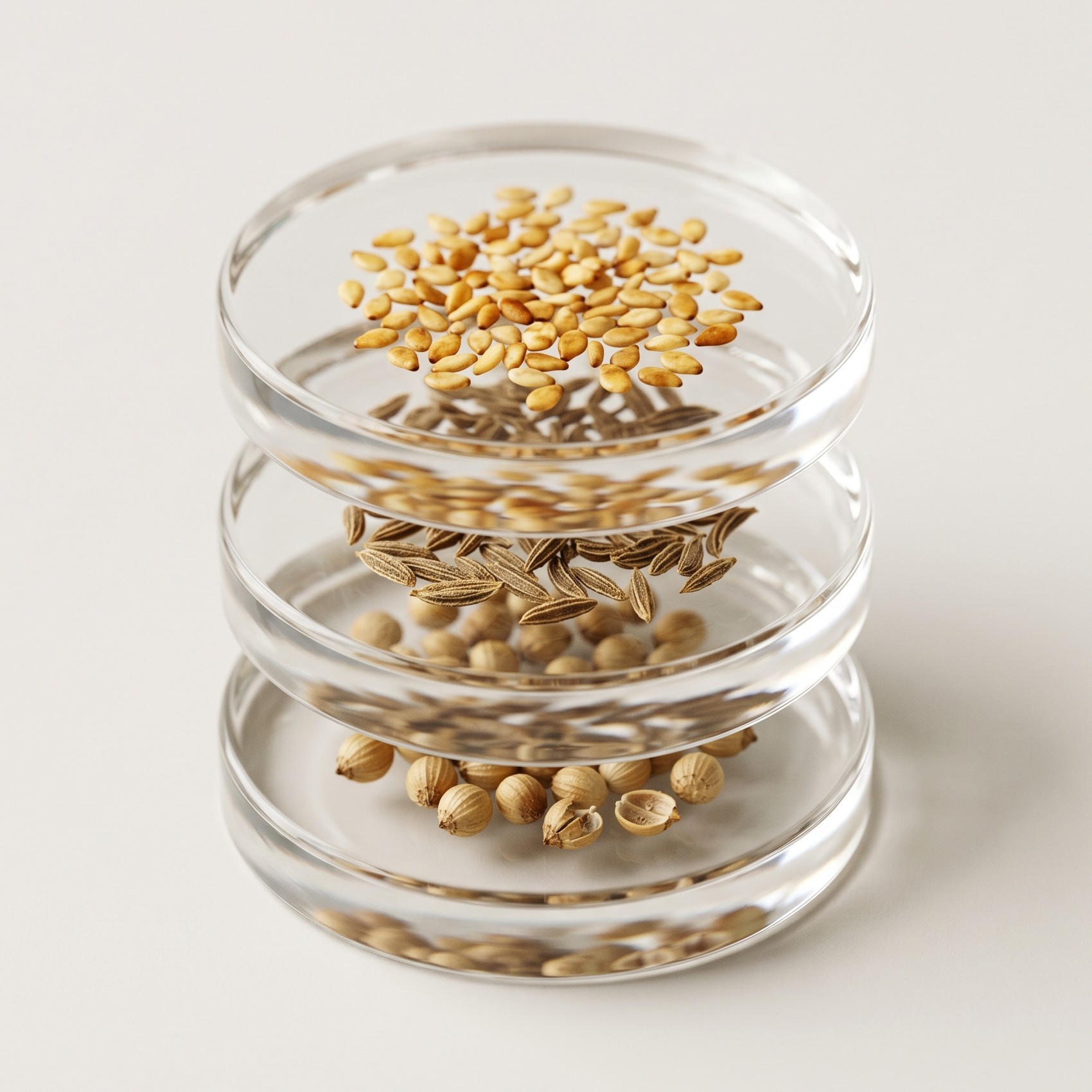
There is a category of oriental fragrance that smells like the idea of an exotic place — warm, resinous, spiced in a generic direction, comfortingly foreign without being too specific. You can identify it as "oriental" immediately and feel nothing in particular about it, because it points toward nowhere real. And then there's a different category that smells like a specific kitchen, a specific market, a person who actually lives in the world it's referencing. Usually, the difference comes down to a few specific ingredients that commercial perfumery uses less often or less conspicuously.
Sesame, cumin, and coriander belong to the second category. They're food ingredients before they're perfumery ingredients, which is precisely what gives them their power.
Sesame
Sesame oil is one of the most culinarily distinctive smells in East and Southeast Asian cooking — the nutty, warm, slightly fatty character of toasted sesame in a hot wok, in cold noodles, in banchan, on the hands of someone who cooks with it daily. Sesame paste carries a related but distinct character in tahini. It's embedded in the actual sensory environment of Chinese, Japanese, Korean, and North African cuisines in a way that no generic "oriental spice" is.
Sesame is unusual in perfumery because it doesn't create an abstracted impression of a place. It triggers the actual sensory memory of that place. The distinction sounds trivial and isn't. Most fragrance notes work through suggestion: the lavender field, the rose garden. Sesame works through recognition. If you've spent time in Korean street food stalls or at a Chinese family dinner, the toasted sesame note in a fragrance doesn't suggest those environments, it almost literally re-enters them.
The technical complication is that sesame oil itself is a carrier oil, rich in fatty acids and unsuitable for direct fragrance formulation. Perfumers work with CO2 extraction, which captures the aromatic profile of roasted sesame — the pyrazines formed during roasting that produce the nutty character, the underlying fatty warmth — in a concentrated form suitable for the intended fragrance application. The result blends well with vanilla, woody materials, and oriental accords, where it provides warmth that reads as somehow more genuine than amber or vanilla alone. Hermès Ambre Narguilé from the Hermessence collection is the most prominent example: sesame in the top accord alongside rum, cinnamon, and caramel creates the specific kind of gourmand oriental warmth that doesn't feel synthetic or imagined. It feels borrowed from a real kitchen.
Sesame is unusual as a named focus in perfumery, even in niche. The rarity is informative: sesame doesn't produce a diffuse, broadly marketable exoticism. It produces a specific cultural reference, which can be especially powerful for wearers who carry that reference as a memory. That's a narrower market than the generic oriental accord, which explains why most brands don't go there.
Cumin
Cumin is the most demanding ingredient in this category and the most interesting.
The characteristic smell of cumin in food, earthy, warm, slightly penetrating, anchoring the cuisines of North Africa, India, and the Middle East, comes from a group of compounds called cumin aldehydes, principally cuminaldehyde. At trace concentrations in a fragrance, these produce genuine exotic warmth: earthy, spiced, distinctly authentic in the way no synthetic "spice accord" achieves. At moderate concentrations, they begin to read as sweaty. At higher concentrations, unmistakably so.
That is not a failure of the material. It's the same concentration-dependent character shift we've discussed with indole and white florals: a molecule that occupies two registers depending on dosage, with a threshold between them that has to be managed precisely. The association with skin is not merely fanciful. One of the major axillary odor compounds, 3-hydroxy-3-methylhexanoic acid (HMHA), is actually described by researchers as having a cumin-like odor. The overlap is recognizable even though the spice and the underarm produce it through different chemistry.
That is why cumin works at trace concentrations: it connects to the olfactory memory of human skin chemistry in a way that most spice materials don't. When used well, at concentrations that stay on the right side of the threshold, in compositions that give it warmth and lift rather than heaviness, it produces a character that smells like closeness. Not a concept of warmth. The actual warmth of a specific person in a specific context.
Commercial perfumery mostly avoids it, for obvious reasons. The risk of getting the concentration wrong is immediate and unambiguous. The perfumers who use it well tend to be those with Middle Eastern market experience or a natural materials orientation — contexts where the spice vocabulary is treated as a palette rather than a hazard.
Coriander
Coriander is two ingredients in one plant, and they are almost entirely different.
Coriander seed, distilled as an essential oil, has a warm, woody, citrusy, slightly spicy character. It's a sophisticated, relatively gentle spice note used in orientals, fougères, and woody compositions — less assertive than cumin, more citrus-adjacent, with a clean aromatic quality that blends well without demanding its own phase. This form of coriander is the one that appears in mainstream and niche fragrance pyramids under the spice category.
Coriander leaf, cilantro, is a different material entirely. The characteristic fresh, green, slightly soapy-astringent quality of fresh cilantro comes from aldehydes that overlap structurally with the "soapy" character of certain musks. Some people experience these aldehydes as foul rather than pleasantly herbal, with both genetic variation and familiarity contributing: a bitter, soap-like, even bug-like quality. For those who enjoy it, fresh cilantro has a distinctive brightness that is one of the clearest olfactory markers of Vietnamese, Thai, Mexican, and certain North African cuisines.
In the context of pho specifically — the Vietnamese broth whose complex aromatics include star anise, clove, cinnamon, cardamom, and charred ginger, with fresh cilantro and basil added at service — the coriander leaf contributes the freshness that prevents the warm base spices from becoming heavy. The broth without the fresh herbs is rich but one-dimensional; the addition of cilantro pulls in a green register that lifts the whole composition. Fresh coriander serves exactly this function in perfumery compositions that need it: contrast, lift, a green edge that prevents warm oriental structures from closing in on themselves.
The seed and the leaf, in perfumery as in cooking, are tools for different problems. The seed goes toward deepening and connecting; the leaf goes toward brightening and opening. Using both in the same composition isn't obvious, but the food context suggests it works: cooking offers plenty of reasons to consider the seed and fresh leaf together rather than treating “coriander” as one fixed character.
The common logic across sesame, cumin, and coriander is that they bring cultural specificity that more abstracted ingredients can't reproduce. What interests me in these notes is the smell not of the concept of a place but of the actual place. That specificity can work especially strongly for people who have the referent, who know the smell of real tahini, or a real Middle Eastern market, or a real bowl of pho. For those people, these ingredients in a fragrance don't evoke a mood. They evoke a location and, often, a person.
The effect is narrower, but more powerful, than general exoticism. It's the difference between a fragrance that suggests somewhere warm and distant and one that puts you, specifically, somewhere you've actually been.