Saffron: The Veil of Gold
- Perfumery
- Design
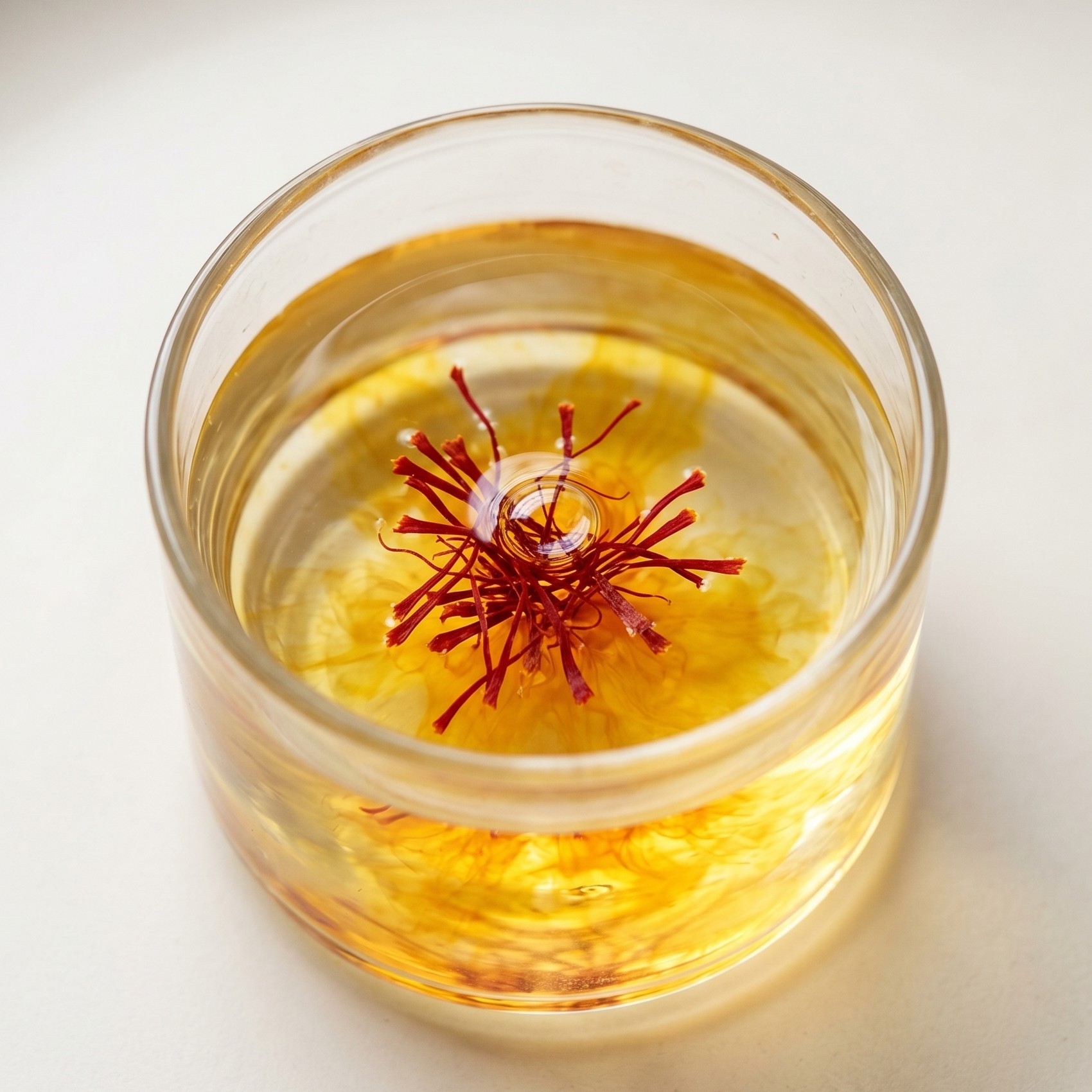
Saffron is one of the most expensive spices in the world. It is usually cited as trivia about an impractical spice. But in the context of perfumery, where a fraction of a percent of material can define an entire composition's character, it suggests something about the nature of what saffron actually does. You don't use it in volume. You use it as a presence.
A note that refuses location
The effect of saffron in a fragrance doesn't follow the logic of most notes. Most ingredients are locatable: you smell the rose in the heart, the vetiver settling into the base, the bergamot burning off the opening. They occupy their moments and their phases. Saffron doesn't occupy a phase. It diffuses through the entire fragrance — present at the opening, persistent in the drydown, not especially loud at any point but audible throughout. It doesn't blend with the other notes so much as it covers them. You don't smell saffron and the rose underneath it. You smell the rose through saffron, as if the fragrance has been steeped in it the way milk takes on the character of what is steeped in it.
Several materials can produce the saffron effect. Safranal is an important aroma compound in the spice itself; synthetic materials such as Safraleine can supply a persistent saffron-like, leathery-spiced character too. A saffron note does not tell us which one is in the bottle. The veil is how I experience the result: a quality that remains perceptible through the surrounding notes, rather than announcing one isolated phase.
The character of safranal is not what you might expect from a spice. It's metallic, honeyed, and slightly leathery all at once: not the warm straightforward sweetness of vanilla, not the sharp heat of pepper, but something more ambiguous. There's a dry-hay quality, sun-baked and warm. A medicinal edge that reads as bitter-iodine at the extreme but at proper dosage produces an intriguing sharpness. And underneath these a faint animalic warmth — the same quality that makes saffron feel intimate and slightly skin-adjacent rather than purely botanical.
What it does to surrounding materials is entirely dependent on what those materials are. Paired with leather and oud, saffron becomes dark and smoky — a gilded leather, smoked honey. With rose, it pulls the floral into metallic-spiced territory, adding a depth that vanilla or patchouli couldn't produce without changing the rose's character entirely. With amber and resins, the honeyed facet amplifies and the whole thing becomes richer, more languorous. With vetiver, the combination we'll return to, it takes on an entirely different, more austere character. The veil doesn't have a fixed color. It shifts temperature depending on what it covers.
One detail worth flagging for those who've engaged with the transformation article in this series: saffron belongs in that category too. The fresh stigma of Crocus sativus smells faintly grassy. Much of its characteristic safranal develops during drying through reactions involving the precursor picrocrocin. Much of the aroma that defines saffron’s identity in both cooking and perfumery is a product of processing. The drying process is the ingredient.
The luxury of difficulty
The luxury association is partly historical: saffron is laborious to harvest and expensive to buy. But its use as a perfume note is much wider than that price suggests, helped by synthetic materials. What reads as expensive to me is the effect, the ambiguous metallic-honeyed-leathery character, rather than proof that a costly natural ingredient went into the bottle. The affordable example below makes that distinction particularly interesting.
The other dimension is what the veil does to perception. A fragrance with saffron feels ambiguous in a specific way — harder to classify, harder to trace, more enigmatic. The metallic-honeyed-leathery character doesn't map cleanly onto the familiar note categories. You know something is there; you can't quite name what it is. This ambiguity is the source of the depth perception. It reads as mature, complex, knowingly sophisticated, the olfactory equivalent of a sentence that means slightly more than its literal words.
Saffron at the table
The food context is useful for understanding saffron's contextual character because saffron behaves in food exactly as it behaves in perfumery: it changes completely depending on what surrounds it.
Paella is the most culturally familiar reference point for most people, but it's actually a poor showcase for saffron's character. In a heavily seasoned seafood paella, saffron may sit among paprika, garlic, stock, and other aromatics that collectively dominate the composition. What saffron contributes is largely the golden color and a faint earthy warmth that you'd miss if it were absent but can't isolate when it's present. The metallic, honeyed facet is buried under more aggressive ingredients.
Persian rice, chelo, is the better demonstration. Saffron bloomed in hot water and added to white rice in the final minutes produces something where you can actually taste the molecule: the honeyed quality comes forward, clear and slightly luminous, the metallic edge barely present, the overall impression warm and subtly exotic. The simplicity of the dish lets saffron speak.
Persian desserts go further. In saffron rice pudding or saffron ice cream (bastani), the sweetness pulls the honeyed facet almost entirely to the foreground and the animalic-bitter edges recede. The same molecule in a sweet dairy context tastes almost floral. Milanese risotto does something similar: the richness of Parmesan and butter transforms saffron's character toward creamy-honeyed, the metallic quality softened by fat. Iranian meatballs, where saffron is bloomed directly into warm meat, push it toward the earthy-animalic register: less honeyed, more of the leathery warmth.
Saffron has no fixed character; it amplifies and reflects the context. It makes everything it touches slightly more golden, slightly more ambiguous, slightly more itself, and which version of that ambiguity emerges depends on what it's embedded in.
Saffron in the bottle
In fine fragrance, the most discussed saffron context is Maison Francis Kurkdjian's Baccarat Rouge 540. The saffron-jasmine-amberwood construction became, through the 2020s, almost the defining reference for a certain kind of contemporary luxury fragrance — warm, skin-adjacent, metallic-sweet, intensely present but impossible to break into its components. Whether or not one finds Baccarat Rouge interesting on its own terms, it demonstrates saffron's potential for creating exactly the veil quality described above: you smell the jasmine and the amber through the saffron, not alongside it.
A more unexpected example is Zara's Vetiverich. Positioned as a mass-market masculine fragrance, it uses saffron, pear, and bergamot over violet leaf and jasmine leaf, with vetiver and cedar in the base. It should not work as well as it does. What it achieves is a specific kind of ambiguity that reads simultaneously as boyish and formal — fresh enough for a young register, complex enough that the vetiver-saffron combination produces something that feels knowingly composed. The saffron here pulls vetiver's earthy character through the same metallic veil, producing something more structured and less straightforward than vetiver alone. At its price point, the formulation is genuinely interesting: the characteristic richness most buyers of commercial masculine fragrances don't know to expect, delivered at a fraction of the cost it would carry in a niche bottle.
In each case, the fragrance is the food context: the surrounding ingredients determining which version of saffron's character comes forward. The veil is the same. What it reveals changes.