The Ingredient Is the Transformation
- Perfumery
- Research
There's a category of perfumery ingredient that smells nothing like the organism it comes from. Not slightly different, nothing like it. The living thing and the perfume material bear almost no olfactory relationship to each other. The smell you're experiencing is a product of time, fermentation, infection, decay, or stress acting on biological raw material. The organism is just the starting point. The chemistry that produces the smell happens afterward.
Understanding this changes what "natural ingredient" means, and it has something interesting to say about the relationship between beauty and transformation.
Vanilla and the curing chamber
Vanilla is the clearest example because most people know vanilla as a taste and smell, and assume the vanilla bean simply contains that smell the way a lemon contains citrus.
It doesn't. Fresh, just-harvested vanilla beans from Vanilla planifolia orchid flowers are green and essentially odorless, or carry a faint vegetal, slightly grassy quality that bears no resemblance to the familiar warm, sweet, complex character of cured vanilla. The vanillin (the primary aromatic compound responsible for vanilla smell) exists in the fresh bean mostly as glucovanillin, a glycosylated form that has no smell. It's locked to a glucose molecule like a key inside a lock.
Releasing it requires curing: a carefully managed process of killing the beans (by blanching them in hot water or briefly freezing them, depending on the regional tradition), then sweating them wrapped in blankets for weeks at carefully controlled temperature and humidity, then slow-drying them over months, then aging them further before use. The sweating phase is the critical one: the killing of the bean activates enzymes that cleave the glucovanillin into vanillin plus glucose. The smell emerges not from the living plant but from its controlled death and the biochemical cascade that follows. The entire process takes three to four months minimum, and higher quality material is aged longer. A vanilla bean that hasn't been cured doesn't smell like vanilla at all. Somewhere in the curing process, vanilla becomes vanilla.
Years of oxidation
Orris butter — the intensely violet-woody-powdery iris extract that anchors countless high-end fragrances — requires a process so extended that it makes vanilla curing look rushed.
The iris rhizome in its fresh state is, depending on the source you consult, either practically odorless or carrying a disagreeable green and herby smell. There is no violet, no powder, no suede. The characteristic odor compounds (irones) don't exist yet in the fresh root. They form through the oxidative degradation of precursor molecules called iridals, a slow chemical transformation that requires air and time.
The rhizomes are grown for several years before harvest, then dried and aged while iridal precursors transform into the irones responsible for the characteristic scent. The exact timetable varies; growing and postharvest preparation together can take four or five years or longer. Distillation then produces orris butter, a costly material whose character depends on all that preparation.
The familiar iris note belongs to the prepared rhizome, after years of growth and aging.
Trees that smell only when wounded
Agarwood inverts this logic. The tree doesn't produce its aromatic compounds in response to time or careful processing. It produces them in response to attack.
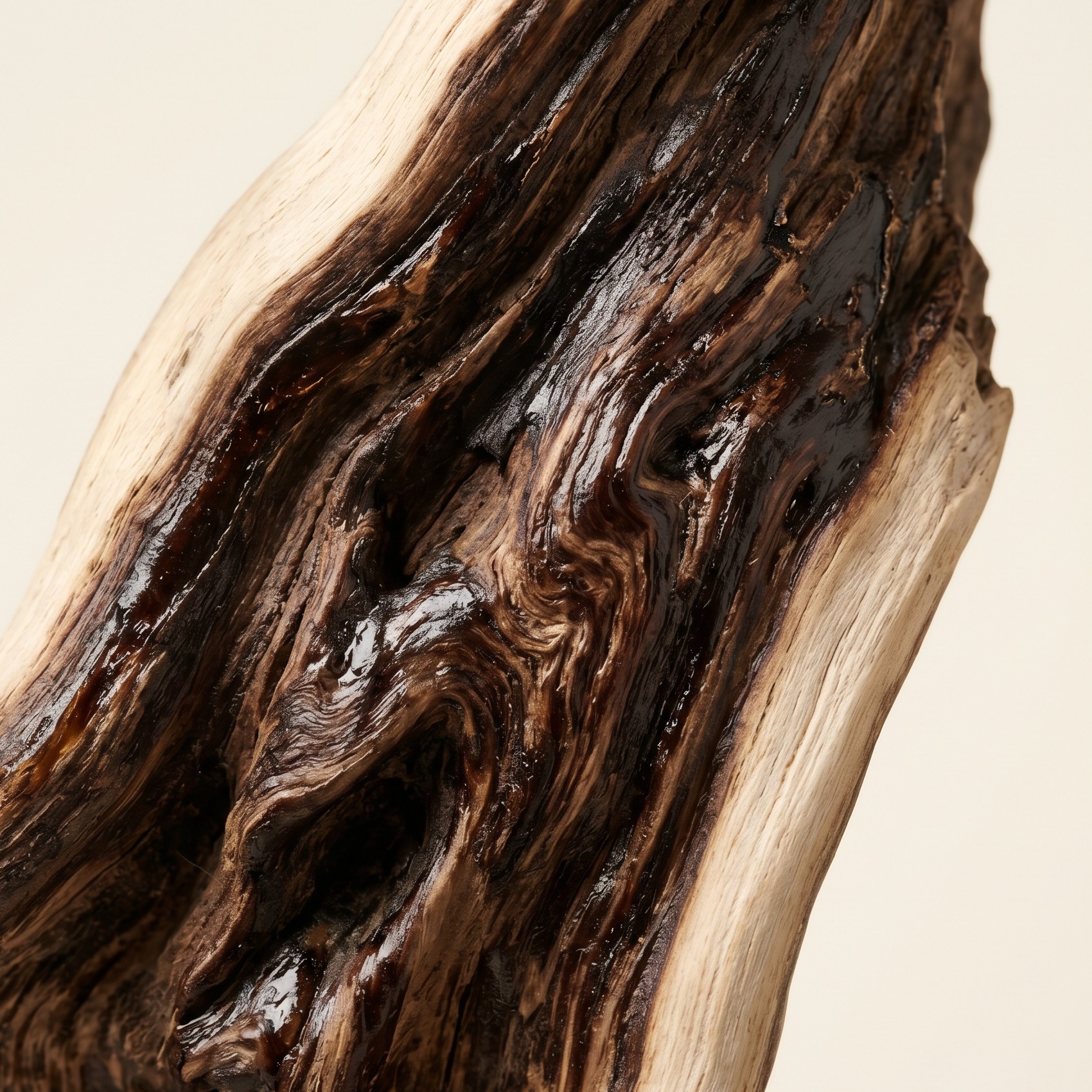
Healthy agarwood trees (Aquilaria species, native to parts of South and Southeast Asia) have no significant smell. The prized oud fragrance forms when the tree responds to injury and associated biological stress, often involving fungi, producing a dark, dense, resinous material as a wound response: essentially an immune reaction, scar tissue at the aromatic level. The infected, resin-saturated wood is what's harvested and distilled. The smell of oud is the smell of the tree's stress response to disease. Cultivation can induce the response through physical, chemical, or biological methods.
Perfumery repeatedly exploits the same natural pattern: the organism under stress produces compounds it would never generate under normal conditions. The most valued material comes from the most compromised specimen.
Ambergris takes this transformation furthest in time. It forms in the intestines of sperm whales — likely as a response to irritation from squid beaks, the remains of the whale's primary food — and in its fresh state has a fecal, marine, distinctly unpleasant quality. Whales occasionally expel it into the ocean, where it begins decades of slow oxidation under sun and saltwater. The longer it floats, the more the raw and biological character burns off, and the more it develops the warm, sweet, earthy, extraordinarily tenacious quality that made ambergris one of the most prized perfumery materials in history. Freshly expelled ambergris is worth little. Aged ambergris, found washed ashore after years or decades at sea, commands extraordinary prices.
The ocean is the laboratory. Time is the process. Important parts of the resulting odor, including the ambroxide character, can now be supplied synthetically, which is why it appears in so many modern fragrances under the name "ambergris" or simply as an unlisted synthetic. The molecule you're smelling when you encounter that warm, skin-like, almost saltwater-mineral quality was originally the product of a whale's digestive chemistry plus decades of marine photochemistry. The synthesis bypasses that process but reproduces its output.
The principle, stated plainly
Civet and castoreum follow similar logic. Both involve animal secretions from scent glands (civet from the African civet cat, castoreum from North American beavers) that smell sharp and unpleasant in their raw state and become complex, leathery, animalic, and usable only after dilution and aging. Both have largely been replaced by synthetics in contemporary perfumery. Both produced something beautiful from something that was, in its original state, neither beautiful nor benign.
Tobacco in perfumery usually evokes the cured leaf rather than the green plant. The Maillard and fermentation chemistry of the curing process transforms the green, acrid, relatively simple fresh leaf into the warm, sweet, leathery-dried character used in fragrance. You are never smelling the plant. You are smelling the controlled chemical damage done to it.
The pattern is consistent enough to constitute a principle: in perfumery, the most valued natural materials are those whose aromatic character emerges through transformation rather than existing in the raw biological source. The iris rhizome must age. The vanilla must die and ferment. The oud wood must develop its resinous response. The ambergris changes through weathering and oxidation. The castoreum must be dried and aged.
"Natural" in this context doesn't mean "the organism as it exists in the wild." It means "derived from biological material after transformation." The smell you're experiencing isn't the living thing. It's what happens to the living thing after time, stress, or chemistry has acted on it.
The most valued olfactory materials, orris, oud, ambergris, vanilla, all require either the death of the source organism, disease in it, or an extended period of controlled transformation before the desired quality emerges. The thing itself isn't the ingredient. The thing becoming something else is.
This may be why these materials, used even in small quantities, produce a quality in fragrance that's hard to articulate but recognizable: a depth that reads as organic, as if time has passed, as if something has been through a process. Because it has.