The Fragrance Pyramid Is Partly Fiction
- Perfumery
- Design
A perfume's note pyramid lists its ingredients in three tiers: top, heart, base. You read it and understand what you're about to smell. Bergamot, jasmine, sandalwood. Rose, vetiver, musk. The implication is that these are the ingredients and you'll encounter each of them in sequence as the fragrance develops.
Some of them are real. Many are not.
The pyramid mixes actual extractable ingredients with marketing constructs, fictional accords, and outright invented concepts, and it does so with no visual distinction between them. Understanding which is which changes how you read fragrance descriptions and explains why certain "notes" appear in hundreds of different fragrances smelling completely different from one another, while others appear reliably the same.
Amber names nothing
Amber is the most consequential example. It appears in probably the majority of modern fragrances. It names no ingredient.
Fossilized amber — the prehistoric tree resin that traps insects and ends up in jewelry — has almost no perceptible smell. Whatever aromatic compounds it once contained have long since volatilized or degraded. The perfume industry didn't take its cue from the resin. The word was borrowed from the color: the warm golden-brown tonality of certain resinous compositions in late 19th century perfumery, anchored by synthetic vanillin (newly synthesized at the time) alongside labdanum and benzoin. That accord was named amber because it looked amber-colored in the bottle and had a warm, ancient quality. The name stuck.
When a perfume lists "amber" as a note today, it means a combination of labdanum (a resin from Mediterranean cistus rock rose), benzoin (a tree wound resin with warm vanilla-caramel character), and vanilla, sometimes with tonka, styrax, or patchouli, sometimes with ambroxan (a synthetic molecule from the ambergris chemical family). Every house, every perfumer uses a slightly different interpretation of this accord. There is no single amber. There is only the concept of amber as a warm-resinous-sweet direction, executed differently by everyone who invokes it.
That is why "amber" in the base of a fragrance tells you almost nothing. It could mean deep, balsamic, animalistic. It could mean soft and clean and barely-there. The word is a category, not an ingredient.
Notes that point to no material
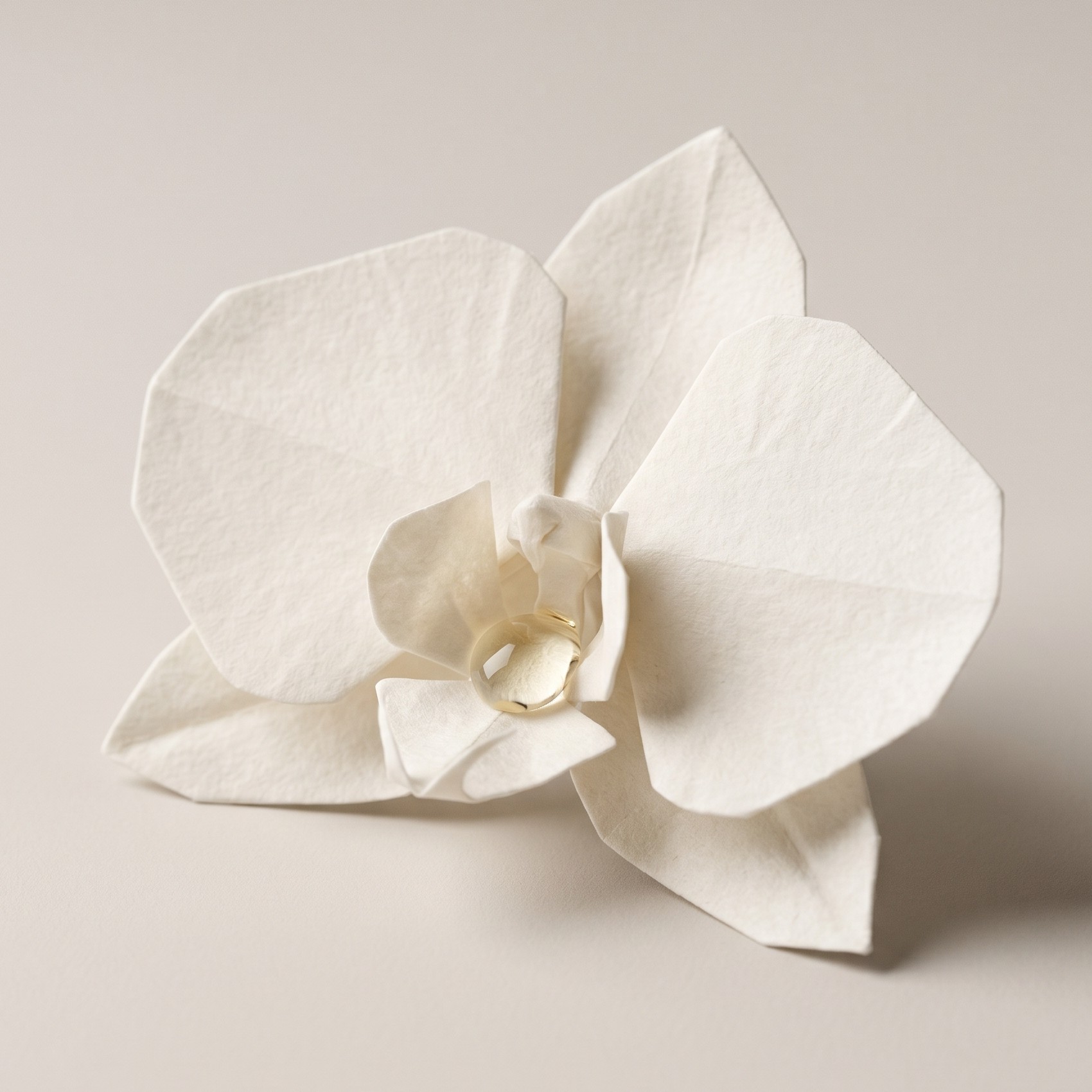
Orchid, as a marketed floral note, rarely identifies a standard extract with one agreed character. Orchids are a vast and varied family, including vanilla; the floral label is much less botanically specific than it sounds. When a fragrance lists orchid, it means a synthetic accord designed to evoke what someone imagined orchid should smell like: typically something floral, soft, slightly sweet, slightly powdery. The "orchid note" varies enormously between products because there's no reference material. Every orchid accord is an interpretation of a phantom.
Bamboo is similar. Cut bamboo has a faint green, woody, slightly watery smell, but there's no bamboo extract used in commercial perfumery. The bamboo note in fragrances is a synthetic green-fresh accord, typically aqueous and slightly woody, carrying the concept of bamboo rather than any actual bamboo-derived chemistry.
Cotton and cashmere are textile metaphors applied to olfactory materials. Cotton doesn't have an extractable smell beyond a faint clean-fabric quality. Cashmere comes from goats and is not itself the soft woody-musky material the note suggests. Neither is a perfumery ingredient. One material associated with this vocabulary is Cashmeran, synthesized in 1968 by John Hall at IFF — the same chemist who later gave the world Iso E Super. Cashmeran has a soft, warm, woody-musky-amber quality that someone decided was evocative of cashmere fabric. It's listed as "Cashmere Wood" (there is no such tree), "Cashmere Musk," or "Cotton" in various marketing contexts. When you smell the "cashmere" in a fragrance, Cashmeran may be contributing to that impression.
The ocean as synthetic
Aquatic and marine notes are perhaps the most discussed synthetic accord category of the past forty years. The smell of the ocean is not extractable. It varies by location: the Atlantic doesn't smell like the Pacific, and neither smells like the Mediterranean. One hugely influential material in the modern marine vocabulary is Calone, developed in the 1960s and strongly associated with the watery-melon vocabulary of fragrances such as Issey Miyake’s L’Eau d’Issey (1992). Calone has a specific, distinctive ozonic-watery-melon quality that the fragrance industry decided represented "ocean." It then appeared in approximately every masculine and fresh fragrance through the 1990s and early 2000s.
When people say they find aquatic fragrances generic, they're usually detecting Calone. When people say they smell "the ocean" in a fragrance, they may be recognizing a learned perfumery convention as much as a memory of a particular coast.
The constructs themselves are not the problem; they are valid tools, and some produce extraordinary results. Cashmeran is a wonderful ingredient regardless of whether cashmere actually smells like it. The note pyramid implies a straightforwardly descriptive relationship between label and ingredient that doesn't hold.
Real extractable materials give you a more definite reference, although they vary too. A Rosa damascena absolute belongs to a recognizable family, with substantial variation from origin, extraction, processing, and age. A synthetic construct listed as "amber" will smell however the perfumer designed that particular accord to smell. Two fragrances can list "amber" and smell nothing alike, because one is labdanum-forward and heavy and the other is ambroxan-forward and clean and cool.
The practical consequence is that learning to read a note pyramid requires knowing which words name real materials and which name conventions. Bergamot, vetiver, iris, jasmine, sandalwood, neroli, rose, patchouli: these are extractable ingredients with consistent identities. Amber, orchid, bamboo, aquatic, cotton, cashmere, driftwood, sea salt, rain, breeze: these are concepts, with execution varying from house to house and formula to formula.
One more: musk. Natural musk from musk deer and other animalic materials, including civet and castoreum, have largely given way to synthetics, with conservation, welfare, cost, and availability all playing a part. Almost every "musk" in contemporary perfumery is synthetic: Galaxolide, Helvetolide, Ambrettolide, Ethylene Brassylate, and others. When a fragrance lists "musk," it may be referring to any of dozens of different synthetic molecules with meaningfully different characters. Clean white musk, animalic dark musk, skin-adjacent musk, fabric-softener musk: all listed simply as "musk."
The pyramid is useful. It gives you a directional sense of what you're about to smell. But it's half description and half creative writing, and knowing which half is which is a necessary part of reading it well.