Dominique Ropion and the Problem of Integration
- Perfumery
- Design
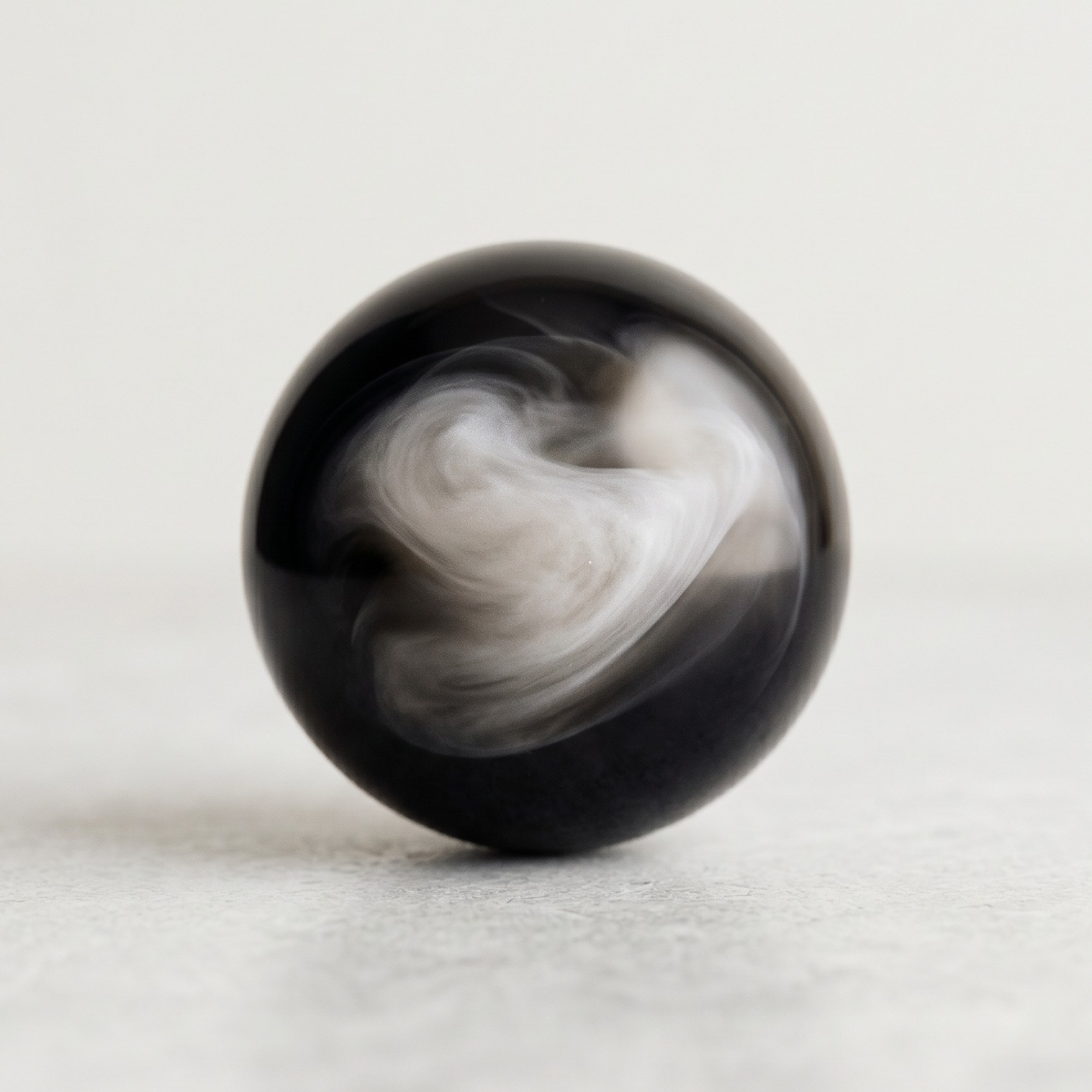
There is a class of perfumes that smell like a collection of things, and a class that smell like one thing. Most perfumes belong to the first category. You can follow the logic: here comes the citrus, now the heart is opening, the base is arriving. The fragrance hands you a sequence. You receive it.
Ropion makes the second kind.
I noticed this while wearing L'Interdit Intense, and confirmed it on skin with Absolu. What struck me wasn't any individual note; it was the absence of edges. There is no moment where you catch the transition. The fragrance doesn't move from one phase to the next; it continuously is. Dark, rounded, circular, self-referential. The tuberose doesn't sit above the patchouli. They are not layered; they are blended in a sense that goes deeper than the word "blended" usually implies.
That integration is harder than it sounds.
In signal processing, when you add two waveforms together, you get interference: the sum of their peaks and troughs. You can still read the result as two signals. Convolution is different. You pass one signal through the impulse response of another and get something that neither signal alone contains: a new function whose character depends on their relationship. That relationship is what the perfume’s integration brings to mind.
Ropion's compositions feel convolved rather than added. The florals and the dark base materials don't exist in superposition; they've been transformed by each other. That is why you can't pull them apart in your mind while wearing them. There's nothing to pull apart. The integration isn't cosmetic.
In rendering, the analogous distinction is between flat shading and smooth shading. Both work from the same underlying geometry. But flat shading exposes every face — you see the mesh, the seams, the polygon boundaries. Smooth shading interpolates normals across faces and the surface reads as continuous. The structure is identical; what changes is whether the boundaries are legible.
The materials he consistently works with are not incidental to this. White florals such as tuberose, orange blossom, and jasmine can supply an immediately recognizable brightness, alongside richer and more persistent facets. The interesting problem is how that character relates to the darker materials over time. Patchouli and vetiver, by contrast, are persistent and low-frequency. Earthy, almost animalic, they would anchor heavily if treated as a base in the traditional sense.
The obvious move — the flat-shaded move — is to let the florals carry the top and let the dark materials anchor the bottom. Many perfumes do exactly this and it's fine. You get a floral with a dark base. Two distinct phases.
Ropion does something more interesting. He introduces the dark materials into the floral phase itself, not as a later arrival but as part of the initial condition. The darkness is present from the opening, just not dominant. And the florals persist into the drydown, just transformed. Neither fully departs. The result is that the fragrance has depth from the first second, and brightness in the final hour. It doesn't move from light to dark. It was always both.
That creates the circularity. When a fragrance has a clear directional arc — bright to heavy, fresh to warm — it feels linear. You know where it's going. When the components are present throughout but in continuously shifting ratios, the temporal dimension becomes less like a path and more like an orbit. You return to the same character, just from different angles. That's what I mean by circular.
Ropion has described himself as an adventurer in perfumery, someone who uses "excessive doses of powerful ingredients" balanced against "meticulously measured, subtler accords." This framing is revealing. It's not about restraint; he's not minimalist. It's about ratio management across time. The power is there; what's controlled is when it reveals itself and how it relates to everything else at each moment.
The problem is compositional in the precise sense. A composer solving a similar problem in music wouldn't think about which instruments play; they'd think about the voice leading, the counterpoint, the way each line supports and transforms the others. Ropion isn't choosing which notes to include. He's solving for how they move relative to each other across the duration of wear.
The L'Interdit line demonstrates this across multiple briefs. The original, the Intense, the Absolu, the Rouge flankers: these are genuinely different olfactory objects. Different materials, different accords, different characters. And yet they share something structural that isn't captured by "DNA" or "family resemblance." What they share is an approach to time. None of them hand you a sequence. All of them hand you a state.
Roundness, in this reading, is not a texture or a quality of individual notes. It is what happens when the boundaries between components are removed, when the perceptual experience stops being analytical (I can identify the tuberose, I can identify the patchouli) and becomes synthetic (this is one thing). The note pyramid is a useful pedagogical tool for understanding what's in a fragrance. But the best fragrances make the pyramid invisible. You're not climbing a structure; you're inside a room.