East Asian Drama and the Tolerance for Theatrics
- Film
- Culture
- Design
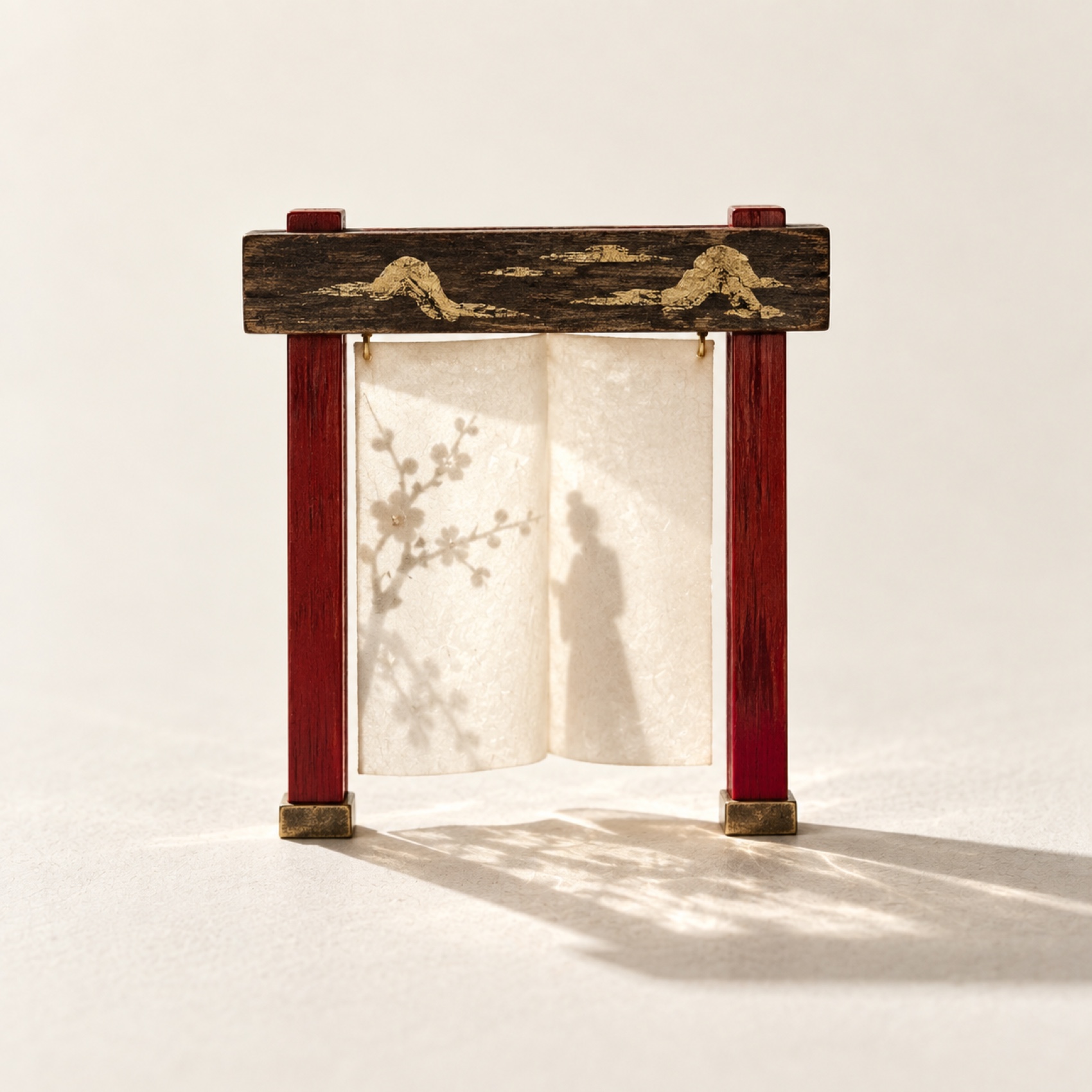
A Western drama arriving at a new location drops white text at the bottom of the frame: Jiang Mansion, Beijing, 1842. It tells you where you are and then gets out of the way. The place itself says nothing. It is a backdrop, not a participant.
The nearest thing a Western drama has to a marker put there on purpose is something that isn't one at all: the road sign that appears as characters drive into a new town, the departure board glimpsed at an airport. Within the scene, both tend to function as practical information rather than commentary. Western architecture has its own moral inscriptions and civic mottos, but the ordinary location marker rarely asks us to read one. When a Western director does want something more openly theatrical from the frame itself (with titles, with transitions, with compositions that announce themselves as compositions) it usually reads as a signature, a self-conscious tradition of its own. Wes Anderson's symmetrical tableaux, his hand-lettered intertitles, his miniature-set transitions are recognizably his, loved exactly because they are his quirk, filed under whimsical or cartoonish. The serious Western drama — the prestige series, the literary adaptation — treats that kind of self-consciousness as something to refuse. The frame must be invisible. Realism is the grammar, and the grammar must not show.
Chinese historical drama starts from somewhere else entirely.
The plaque above the door
A traditional Chinese interior may carry a horizontal wooden plaque high on the central wall, a few large characters cut into it. The biǎn'é names the space, or names what the space is meant to be: Cultivate virtue quietly. Pursue simplicity and elegance. Remember the source. These are not signs in the Western sense (not information posted for people who don't know) but moral frames for the life lived underneath them. The Forbidden City is full of them. The Dream of the Red Chamber describes them. They are part of how a Chinese interior says what it is and what it expects of you. This tradition is not a film invention. It is architecture.
Chinese drama uses it as cinema. In The Double (the 2024 revenge drama set in a fictionalized Song-era capital) the biǎn'é appears throughout, doing two jobs at once. The first is location, given weight instead of a caption: the camera tilts up to the gate plaque as a character arrives, handing you the place and whose place it is and what it stands for in a single held shot. The second is commentary. As a scene closes — a plot set in motion, a lie told, a small cruelty landed — the camera settles on the inscription above. Honor the upright. Act without concealment. That collision is the scene's last beat, delivered by architecture instead of dialogue. The room is not judging anyone. It is just persisting, the way standards do, sitting there unresolved above what happened beneath it. It is the job of a chorus, done in wood and lacquer. No title card is doing this. The world is, because the world was built to.
Memory in the same room
The plaque is not the only place this grammar shows up. The flashback in Western drama tends to displace: fade to black, cut to another place and time, make it clear we have left the present for the past. In The Double, the past often shows up in the same room as the present; the camera shifts a little, the light changes key, and the memory plays out half-lit in the space the character is standing in. Past and present share a stage. It is exactly how theater handles memory, and closer to how memory actually works: not filed away somewhere else but there in the room where you are doing the remembering.
Ashes to Crown, the 2026 drama from the same producer, does it another way: its flashbacks run the past in black and white and keep only the figure the remembering character is fixed on in color. The rest drains to grey. The face, or the object, that the memory is about holds its presence. The technique makes visible what remembering does invisibly: not a neutral replay of the past but a search through it for the one thing that still gives off heat.
Transitions follow the same theatrical logic. In The Double, a conversation ends, the camera holds on one face, and when it reframes the other person has changed; time and place have moved without a cut, the drama running on continuous stage time instead of edited film time. Elsewhere a character moves through the house and the camera follows from a distance, the translucent paper of a sliding door passing again and again between lens and subject: hiding, revealing, hiding again. The weather takes its cue from the feeling in the room: rain at the moment of loss, snow coming down as the confrontation breaks. The wuxia fight choreography turns combat into something close to dance, opponents moving through each other's orbits in a spatial grammar that says as much about their inner states as about their tactics. And the costumes (another thing Western criticism tends to write off as spectacle) work as signal, elaborate and deliberate, carrying social position, emotional state and narrative arc in color and silhouette, with far more in common with stage costume than with anything a person would plausibly wear.
The world of the drama is not a neutral container for the story. It wears its meaning on the surface.
Where the tolerance comes from
The same grammar extends beyond the screen. East Asian societies (Chinese, Japanese, Korean, Vietnamese) retain conspicuous codes of formal behavior in many everyday settings, and those codes run theatrically in ordinary life. The bow, anywhere from a slight nod to deep formal deference, measures out relationship and rank with the body. The kowtow, forehead to the ground before royalty or at an ancestral shrine, is theater of the body in the most literal sense. At a Chinese dinner, the order in which you pour tea or baijiu for the table is not optional; it puts hierarchy into a gesture. At a Korean meal, the younger person does not eat or drink before the elder. These are performances with a grammar, ways of making social meaning visible through the body, and they have survived modernization (changed, kept more carefully in some settings than others, but still there) in a way they largely have not in the West. The palace herald announcing the emperor's arrival at each door is a historical artifact. The instinct behind it is not.
The West has its own formal traditions, but two centuries of industry and everything-must-be-useful have worn them down much further. What survives tends to be either ceremonial exceptions (weddings, graduations, state occasions) or leftovers of an older class system that modern life mostly finds embarrassing. The default is informal: first names right away, dress down, say what you feel and be trusted for it. Formality comes across as stiff, as performed, as fake. The natural and the real are assumed to be the same thing.
The face as the clearest case
Makeup is where this is easiest to see. Mainstream Western makeup officially aims at the natural: a better version of the face you already have. The tan contouring that has run Western beauty for a decade exaggerates what sun and shadow already do to a face; the goal is a face that looks as though it always looked this way. The theatrics are there (contouring is not subtle) but they are working toward a naturalness that has to be built.
The Chinese screen makeup I am thinking of does not share that aim and does not pretend to. Foundation goes on several shades paler than the skin underneath, sometimes more, not for naturalism but for an effect: a porcelain surface the face below does not have. The neck and chest are often left at their own shade, so what you get is a mask centered on the face. Not hidden. Not apologized for. You can see the thickness and the layering, and nobody is pretending you can't. Visible makeup is part of the register.
Inside that, the colors and accents are often more restrained than the Western equivalent (the contour subtle, the eye precise rather than smoky) but the whole effect is still a construction. The under-eye fullness called aegyo-sal in Korean and wòchán (卧蚕, “lying silkworm”) in Chinese, the small under-eye puff that is either natural, played up with makeup, or faked outright with shadow and shimmer, pushes a doll-like brightness; blush lands sometimes on the nose and chin, not only the cheeks. The look is the look of someone made up for the stage. Which it is. Chinese on-screen makeup is made for the camera, built to hold under hot lights, centered on the face as the frame, openly theatrical in a way that Western film makeup (which works very hard to fake off-screen naturalness on screen) is not.
The lens, not the object
That does not make East Asian culture more superficial, or more performative in any sense worth the word. What it has is a higher tolerance for the visible made beautiful: treating the formal, the constructed and the stylized as legitimate registers of meaning rather than failures of authenticity. The bow means something precisely because it is a form, because both people know it is a form and perform it anyway. The plaque above the door means something because someone chose those words and hung them where everyone walking in would see. The rain that falls at the moment of grief is not pretending to be a coincidence.
The Western critical instinct that reads all of this as excess (as melodrama, as stylistic indulgence, as a sign of unsophisticated filmmaking) is not a neutral aesthetic position. It is the position of a culture that decided naturalism was the only serious grammar, and has been watching everything else through that lens ever since.