Black Pepper and the Luxury Register
- Perfumery
- Design
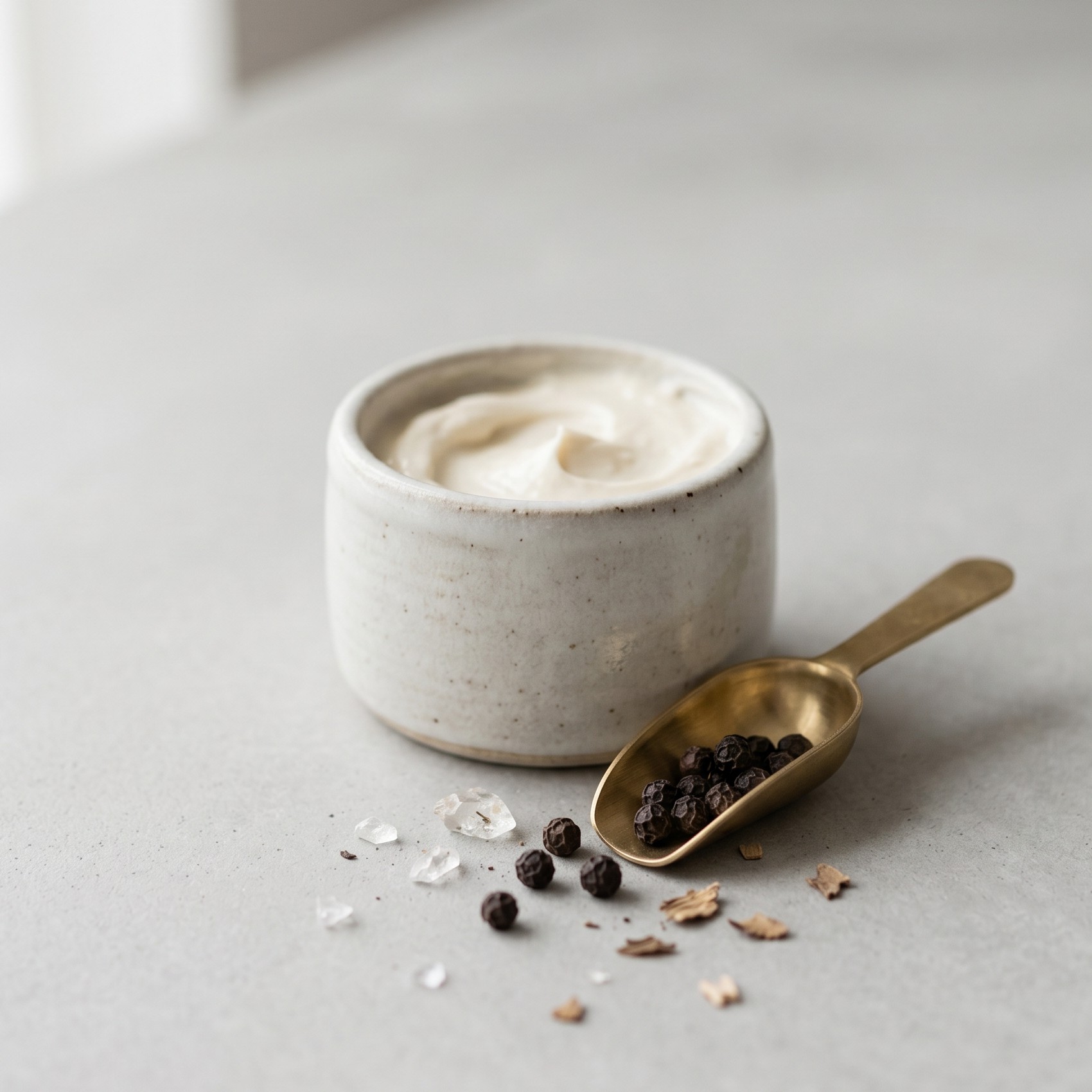
There's a quality some fragrances have that's hard to name precisely. It reads as expensive. Not in the way that a heavy oriental can feel expensive through sheer density of ingredients, but in a more understated way — something dry, refined, slightly austere, adult. The smell of a very good face cream. A certain kind of restraint that signals more sophistication than sweetness would.
Black pepper is often doing that work.
The dry spice
The first thing worth understanding about black pepper in perfumery is that it separates the aroma from the culinary heat of pepper. The heat, the bite, the sneeze-triggering sharpness: those come from piperine, an alkaloid that melts at 128°C and decomposes before it can volatilize. During steam distillation, it stays locked in the plant material and never enters the essential oil. What comes over is purely aromatic: a complex mixture of terpene hydrocarbons that provide much of the aroma of ground pepper, separately from its pungency.
The dominant molecule in black pepper essential oil is β-caryophyllene, a bicyclic sesquiterpene that accounts for roughly 18-28% of the oil, sometimes much more in specific chemotypes. It has a warm, woody, faintly resinous character — closer to clove and copaiba balsam than to anything you'd associate with culinary heat. It functions in perfumery as a bridge molecule: it belongs simultaneously to the spicy register and the woody register, which gives it an unusual ability to sit naturally in compositions built on either axis. It can provide a dry, woody-spicy structure in oriental and fougère compositions: the spice dimension without the sweetness that other spices (cinnamon, cardamom, vanilla) inevitably introduce.
That restraint creates the luxury quality. Black pepper in perfumery is a dry spice. It adds warmth without adding weight, complexity without adding sweetness, and a kind of terpenic contrast that prevents heavy base compositions from becoming muddy. In oriental structures, it delivers spice without the cinnamon-sugar crutch. The warmth can feel like a dry texture rather than a burning sensation, warmth at skin level rather than a burning sensation. That is why it reads the way it does on a high-end face cream: the warmth is subtle, dry, the spice is present but it never announces itself with the directness of food.
The “expensive face cream” association may also be learned. Dry, woody-spicy materials recur in fragranced products, and a familiar texture can carry the memory of the category with it. That familiar product context may be doing some of the work when pepper makes a perfume read as expensive.
Pink pepper, briefly
Pink pepper is a completely different plant used for superficially similar reasons, and the distinction is worth keeping clear.
Pink pepper comes not from the Piper genus at all but from Schinus molle and Schinus terebinthifolia — South American trees in the cashew family, the Peruvian and Brazilian pepper trees respectively. Their chemical profile is almost entirely different from black pepper. Pink pepper is fruity, floral, and fresh, with a mild resinous spiciness that's far lighter and more delicate than the woody depth of black pepper. Where black pepper pushes down toward the woody-oriental register, pink pepper pushes upward: it functions as a top note modifier, adding a nuanced spiciness that feels contemporary and clean rather than warm and dry.
Pink pepper became ubiquitous in niche perfumery through the 2010s, to the point of near-overuse. Its appeal is functional: it solves the problem of making a spicy opening that doesn't commit to the heavy oriental register. It gives fresh and floral compositions a spice facet without changing their overall character. It's more approachable and less demanding than black pepper precisely because it doesn't have black pepper's depth. Whether that makes it better or worse depends entirely on what the composition needs.
The honest assessment is that black pepper is the more interesting material. It's more challenging — it asserts a specific character and the perfumer has to commit to it — and the payoff when it works is the dry, sophisticated quality that makes a fragrance smell like it was made by someone who knew what they were doing. Pink pepper is easier to use and therefore used more widely, which has somewhat diluted its signal value.
Clove and nutmeg occupy adjacent territory and deserve a brief orientation relative to pepper.
Clove derives its character primarily from eugenol, a phenolic compound that gives it a warm, spicy, slightly medicinal quality — the same molecule present in dental materials, which creates an association that perfumers have to manage at higher concentrations. Clove oil also contains β-caryophyllene, giving it a chemical connection with black pepper as well as a place beside it in the spice palette. Clove is warmer and more animalic than pepper; it goes toward tobacco and leather rather than toward dry wood. It anchors oriental accords that need warmth with more weight than pepper provides.
Nutmeg is subtler and more complex: warm, woody, slightly powdery, with a faint soapy quality that can become an asset or a liability depending on context. It lacks the defining molecular character that makes pepper and clove identifiable from their dominant compounds; its aromatic complexity comes from a mixture of terpenes, phenols, and ether compounds that produce a multifaceted quality that's harder to pin down. Perfumers use it more as a modifier than as a signature, the way a chef might use nutmeg: present, contributing to depth, but rarely the thing you point to.
The shared logic across all of these (pepper, clove, nutmeg) is that they function as spice without sweetness. The culinary spice rack also contains cinnamon, cardamom, star anise: all warmer, sweeter, more immediately recognizable and more immediately appealing to a mass palate. The dry spices, pepper especially, make more adult demands. They ask you to sit with something that isn't immediately comfortable. That discomfort is exactly the quality that registers as sophisticated.